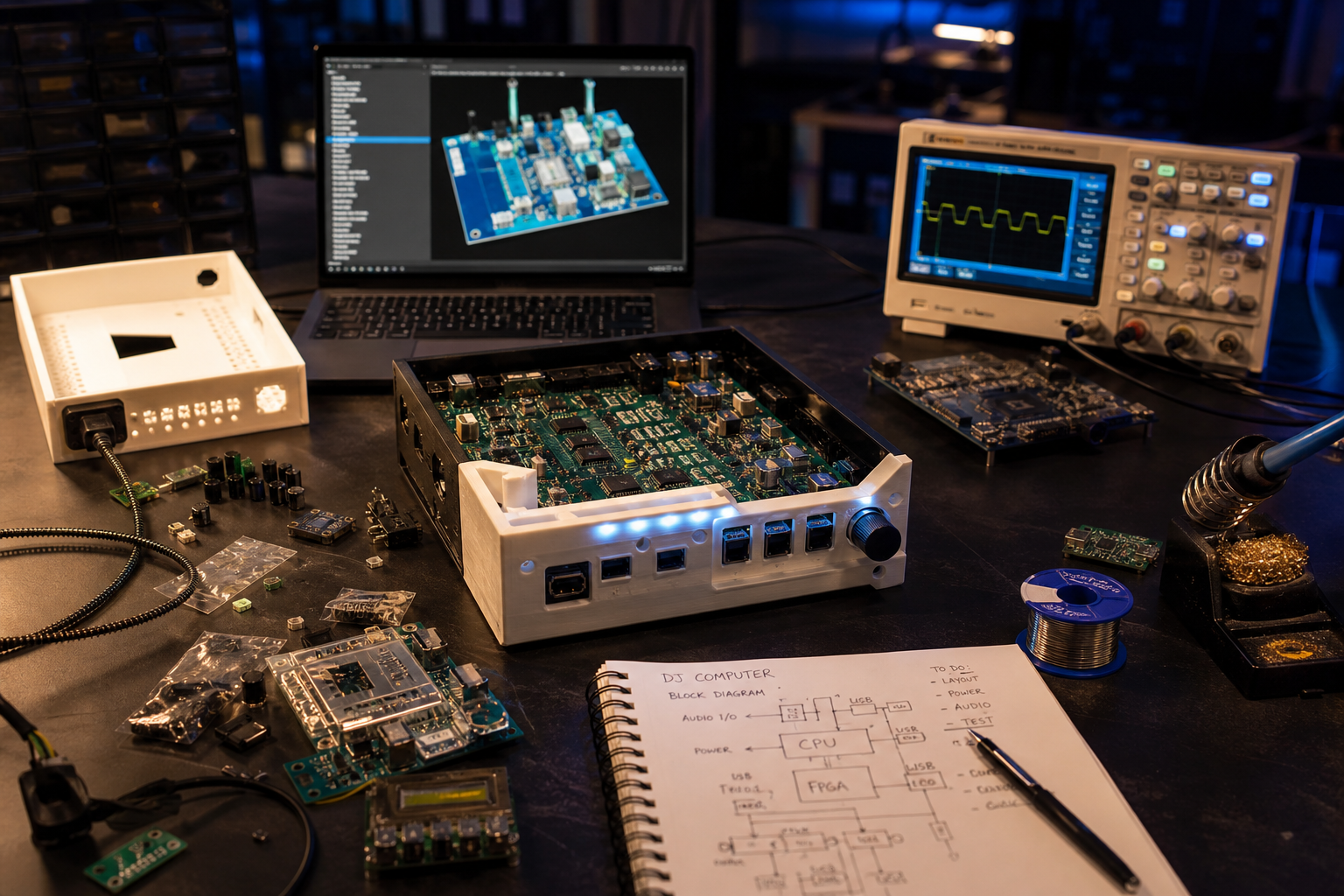
Building NeoDeck wasn't just an engineering project — it was a mission to rethink what a DJ computer should be. Here's the story of how we got from idea to product.
Starting with the Problem
Our founding team are DJs ourselves. We've played clubs, weddings, festivals, and house parties. And at every single gig, the same frustrations came up: laptop overheating on a hot stage, an audio interface that randomly disconnected, 15 minutes of setup before we could play the first track. We knew there had to be a better way.
The First Prototype
Our first prototype was ugly — a Raspberry Pi in a 3D-printed case with an aftermarket touchscreen taped to the front. But it proved the concept: a single-purpose device, booting directly into DJ software, with a controller plugged in via USB. It worked. And it booted in 6 seconds. We were hooked.
The Audio Challenge
The hardest engineering problem was audio. DJs need at least two stereo outputs — one for the main speakers and one for headphone cueing. Consumer single-board computers don't have professional audio hardware. We spent months evaluating DAC chips, testing latency, and designing a custom audio board that delivers studio-quality output with under 5ms latency. It was the breakthrough moment for the project.
Going Fanless
Fans are the enemy of live performance. They add noise, collect dust, and eventually fail. We committed early to a fanless design, which meant carefully managing thermal performance. The NeoDeck chassis itself acts as a heat sink — an aluminum enclosure with internal thermal pads that dissipate heat passively. Even after hours of continuous use, the device stays cool and silent.
Software Integration
Hardware is only half the story. We built a custom Linux-based operating system stripped down to the essentials. No desktop environment, no bloatware, no background services fighting for CPU time. The OS boots directly into the DJ application with audio routing pre-configured and controller mappings loaded. The result is an experience that feels more like turning on a piece of DJ gear than booting a computer.
The Display Decision
Early prototypes were headless — no screen at all. But after testing with real DJs, we realized a screen was essential. Waveform displays, track libraries, effects controls — DJs need visual feedback. We settled on a 10" IPS touchscreen with wide viewing angles and high brightness for visibility in dark club environments. It's large enough to be useful and small enough to not dominate your setup.
What's Next
We're now in the final stages of hardware validation before moving to manufacturing. Every component has been chosen for reliability, performance, and the unique demands of live DJ performance. We can't wait to get NeoDeck into your hands.
Sign up for the waitlist to be among the first to experience the future of DJing.